

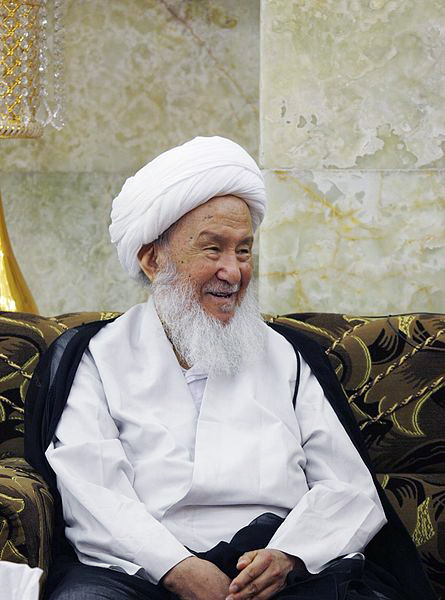
Grand Ayatollah Mohammad Ishaq al-Fayadh was one of four maraji‘ of the Hawza seminary in Najaf, one of the most important seats of learning in Twelver Shi‘ism.
He was born into a humble Hazara family of farmers in the Jaghori district of Ghazni Province, Afghanistan, in 1930. His learning began at the age of five, learning Qur’an from the village imam. At the age of ten his family moved to Najaf, Iraq, where his lifelong pursuit of knowledge began, learning Islamic sciences from renowned scholars.
Henceforth he dedicated his life to the pursuit and mastery of Islamic jurisprudence. He spent decades studying under some of the greatest scholars of his era, most notably serving as a top student for Grand Ayatollah Abu al-Qasim al-Khoei. Through his scholarship, al-Fayadh rose to join the elite four Grand Ayatollahs of the Najaf Seminary alongside Grand Ayatollah Ali al-Sistani.
As well as being a master of the traditional religious sciences, Grand Ayatollah al-Fayadh was known as a quiet reformer who challenged long-held societal conventions within contemporary Islamic jurisprudence. He authored a ten-volume record of Islamic law and supported progressive interpretations regarding the civic and societal capabilities of women. Breaking with stricter traditionalist peers, al-Fayadh authored rulings declaring that women are religiously permitted to hold high political offices and serve as judges. His views bridged deep-seated theological traditions with the complexities of modern social governance.
Throughout Iraq’s difficulties, al-Fayadh navigated complex situations with wisdom and moderation. Having maintained a quietist stance during the rule of Saddam Hussein, he altered his stance after 2003 to carefully engage with transitional processes, advocating for a constitution anchored in Islamic identity while endorsing peaceful coexistence, national unity, and democratic participation.
His death prompted the Iraqi government to declare three days of national mourning, bringing an outpouring of grief from millions of followers, religious institutions, and political leaders globally who mourned the loss of a foundational pillar of modern Shi‘a scholarship.