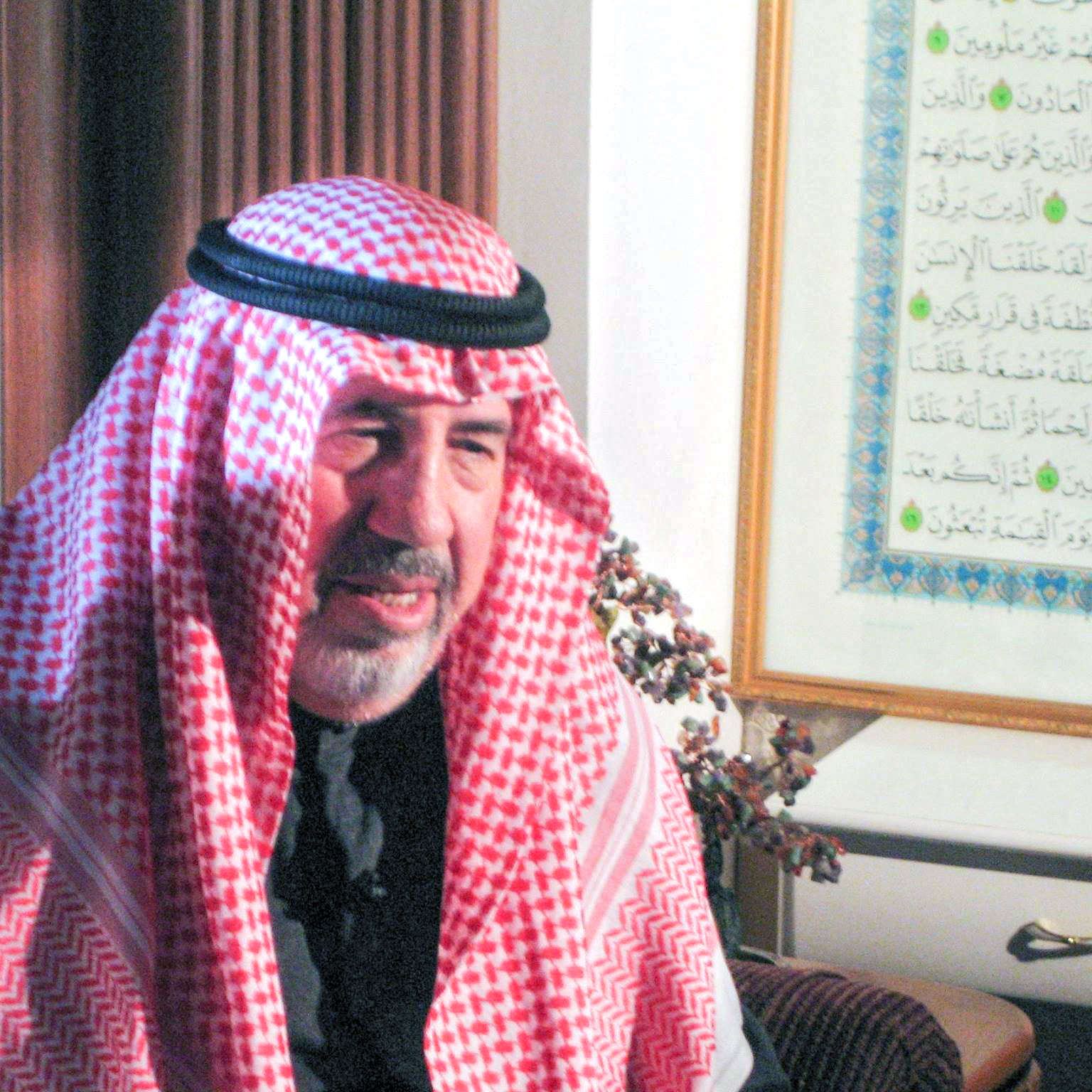
Sheikh Uthman Taha is an internationally acclaimed Arabic master calligrapher. He is universally renowned for hand-scribing the Mushaf Al-Madinah—the official version of the Qur’an issued by the King Fahd Complex for the Printing of the Holy Qur’an in Medina. Scribed over decades, his easily legible and precise script has become the most widely circulated textual copy of the Qur’an globally, exceeding 200 million copies distributed to pilgrims, mosques, and homes worldwide.
Background and Rigorous Training: Born in a rural area near Aleppo, Syria, Taha discovered his affinity for Arabic scripts in early childhood under his father, who taught him the fundamentals of the Ruq’ah script. He moved to Damascus for his higher education, completing a Bachelor of Arts in Sharia from the University of Damascus. Alongside his religious degrees, he rigorously mastered classical calligraphic arts under legendary masters, including Muhammad Badawi Al-Deryani and the Iraqi master Hashim Al-Baghdadi. He earned his ultimate formal certification (ijaazah) in 1973 from the globally respected Turkish master Hamid Al-Amidi in Istanbul.
Scribing the Holy Qur’an: Taha hand-wrote his first complete copy of the Qur’an in 1970. His career peaked in 1988 when he relocated to Saudi Arabia to become the leading calligrapher for the King Fahd Complex. Over his lifetime, he has calligraphed the text of the Holy Qur’an at least 12 times across 6 distinct textual variations (Qira’at), including Hafs (used globally), Warsh (North Africa), Duri (East Africa and Sudan), and Qalun (Libya). His life, methodology, and unique stories—such as his strict practice of never putting pen to parchment without fresh ritual ablution (wudu)—are documented in The Calligrapher of the Revelation, an interactive biographical tribute published by the King Abdulaziz Center for World Culture (Ithra).