

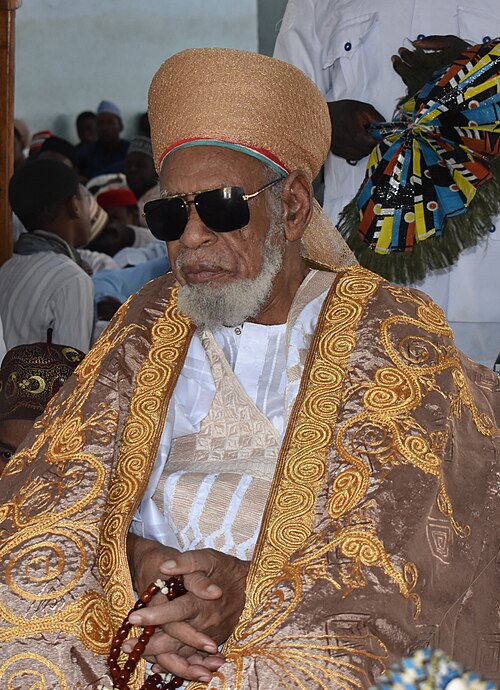
Sheikh Dahiru Usman Bauchi was the Grand Leader of the Tijaniyya Sufi order and was one of Africa’s most towering Islamic scholars. Over his extraordinary lifespan, Sheikh Dahiru came to be regarded as a monumental moral compass and an irreplaceable spiritual beacon across the African continent and the global Muslim Ummah.
He was born in Nafada (then part of Bauchi Province, now Gombe State), and was raised in a devout Fulani family steeped in a rich tradition of Qur’anic education. His lifelong journey of devotion began at home under his father, Alhaji Usman, which led to him successfully memorising the Qur’an by the age of 19. Seeking to deepen his intellectual and spiritual horizons, he travelled to study under legendary global masters, notably aligning himself with the Tijaniyyah spiritual path and eventually marrying the daughter of the renowned 20th-century Senegalese scholar, Sheikh Ibrahim Niasse. His command of Islamic sciences allowed him to launch his annual Ramadan tafsir (Qur’anic commentary) in 1948—a profound delivery from memory that ran uninterrupted for an astonishing 76 years, reaching millions of households across West Africa through national radio broadcasts.
Beyond his intellectual contributions, Sheikh Dahiru was an institution of social reform and mass education. He founded approximately 600 Qur’an schools scattered across Nigeria, Niger, Cameroon, Benin, and Ghana. His commitment to institutional leadership was recognised nationwide through his appointment as the Deputy Chairman of the Fatwa Committee for the Nigerian Supreme Council for Islamic Affairs (NSCIA), as well as receiving the national Officer of the Order of the Federal Republic (OFR) honour for his advocacy of peace and communal harmony.
Sheikh Dahiru Usman Bauchi’s immense impact was visually mirrored in his final send-off, during which hundreds of thousands of mourners from across the world descended upon Bauchi, prompting the state government to declare a public holiday so followers could pay their respects. He leaves behind a huge personal and spiritual lineage, including more than 80 children—nearly all of whom have memorised the Qur’an—and a network of over ten million students carrying forth his teachings. His passing is mourned globally as the end of an era, but his legacy of humility, charity, and unyielding devotion to the word of God remains firmly etched into the fabric of modern Islamic history.