

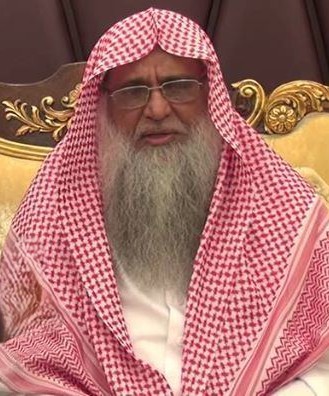
Sheikh Rabee ibn Haadi ‘Umayr al-Madkhali was a highly influential Saudi Arabian scholar, professor, author and speaker, and was known as one of the most radical thinkers in the Salafi movement. His influence reached such that it led to an independent faction within Salafism, his adherents being known as Madkhali Salafis and who presently make up one of the most significant branches of the Salafi movement, a movement characterised by its strict quietist political theology.
He was born in 1933 in Al-Jarradiyah, Saudi Arabia and began seeking knowledge in his village from Ahmad bin Muhammad Jabir Al-Madkhali and Muhammad bin Jabir Al-Madkhali at the age of eight. After completing several classical Islamic texts with him, he started his education at the Ma’had al-‘ilmi in Samtah. His teachers included Hafidh ibn Ahmed Ali al-Hakami, Muhammad bin Ahmad al-Hakami, Ahmad bin Yahya al-Najmi, Muhammad Aman Al-Jami‘ and Muhammad Saghir al-Khamis.
Sheikh Rabee became a towering academic figure who spent decades cultivating students of knowledge, notably as a professor and head of the Sunnah Studies Department at the Islamic University of Madinah. He was a graduate of the Islamic University of Madinah and Umm Al-Qura University in Mecca, and studied under some of the most prominent scholars of the time, including Sheikh ‘Abd al-‘Aziz bin Baz and Sheikh Muhammad Nasiruddin al-Albani. Regarded by his peers as a master of Hadith literature, his extensive writings—such as his critical studies on modern Islamic movements and commentaries on classical texts—anchored his reputation as a meticulous researcher and defender of prophetic traditions. He authored over 30 works, one of the most notable being al-‘awasim mima fi kutub Sayyid Qutb min al-Qawasim (‘A refutation of Sayyid Qutb’s writings’).
Sheikh Rabee advocated for absolute obedience to established Muslim political rulers and firmly opposed political activism, revolutions, and partisan dissent. Through this framework, he positioned his teachings as a means to shield the Muslim Ummah from internal discord and violent militancy, vigorously criticising groups like the Muslim Brotherhood. His doctrinal methodology emphasised an unwavering commitment to the scriptural understanding of the early pious generations.
While his approach to political quietism and stern public refutations generated complex debates across regional and international dynamics, his legacy of institution-building remains undeniable. Generations of his students continue to populate mosques, universities, and digital Dawah spaces worldwide, keeping his methodologies active across the globe.
His funeral prayer was performed at the Prophet’s Mosque in Medina, and was laid to rest in the historic Al-Baqi‘ cemetery. His passing marks the conclusion of a significant chapter in modern Islamic scholarship and global Salafism.