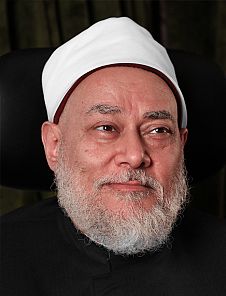
Sheikh Ali Gomaa is one of the most influential contemporary Muslim scholars and the former Grand Mufti of Egypt, a position he held from 2003 until 2013. Even after retiring from this role, he has remained an active public figure, scholar, teacher, and spiritual guide, with his counsel in demand across the Muslim world.
Egypt’s Weight in Islamic Scholarship: Ali Gomaa’s scholarly influence is rooted in Egypt’s central role in Islamic thought and law, especially through Al-Azhar University, where he served as professor of jurisprudence. Gomaa has authored more than 50 books and hundreds of articles on Islamic law, spirituality, and contemporary issues. He continues to be a member of the International Islamic Fiqh Academy, the leading body of Islamic jurisprudence under the Organization of Islamic Cooperation (OIC). However, in 2021, he was dismissed from the International Union of Muslim Scholars, alongside Sheikh Abdullah bin Bayyah and Farouk Hamadeh, due to differing jurisprudential stances, reflecting divisions in global Islamic discourse.
Visit to the Holy Al-Aqsa Mosque Controversy: On 18 April 2012, Sheikh Ali Gomaa, with HRH Prince Ghazi of Jordan, broke what had been a 45-year taboo in some parts of the Islamic World and visited Al-Aqsa Mosque in order to pray there and support the beleaguered Muslim community in Jerusalem. The visit was viewed as controversial in Egypt but set off a change of public opinion in the Islamic World that continues to this day. The Grand Mufti also visited the Church of the Holy Sepulchre, which was much appreciated by the Christian community of Jerusalem.
Personal Popularity: Gomaa was exceedingly popular as a mufti and remains ever-popular since his retirement, although some of his political statements and pro-military government stance after the Egyptian Revolution have dampened this support somewhat. Apart from appearing on popular broadcasts and satellite television programmes, he also revived the practice of informal “knowledge circles” at the Al-Azhar Mosque. At his very well-attended Q&A sessions after his Friday sermons, Gomaa makes a point of taking on anyone who tries to simplify or distort Islamic teachings without knowledge of its traditions. This has made him extremely popular with those who vehemently oppose political Islam as well as also making him a target for some extremist Islamists.
Popularised and Simplified Fatwas: As Grand Mufti, Gomaa transformed Dar al-Ifta into a modern institution with global influence. He introduced a system of checks and balances for issuing fatwas, ensuring they were grounded in authentic scholarship. Under his leadership, Dar al-Ifta became internationally recognised for issuing contextualised and accessible rulings on issues ranging from finance to family law, reaching audiences far beyond Egypt.
Spiritual Guide: Ali Gomaa is also currently the Shaykh of the Siddiqiyya Shadhiliyya Sufi Order which he had registered as an official Sufi Order in Egypt in 2018. Although Dr Gomaa carries two other Shadhili chains: one from the late Shaykh Muhammad Zaki al-Din Ibrahim (d. 1998) and Dr. Hasan Abbas Zaki (d. 2014), he chose the order given to him by one of his main teachers: al-Sayyid Abdullah bin Siddīq al-Ghumari (d. 1993). This is a Darqawi branch of the Shadhiliyya whose chain of transmission is known as a chain of scholars and mujtahids. The Order is currently operating in six countries and has several thousand followers.
The Gaza Genocide: Sheikh Ali Gomaa has spoken forcefully on the ongoing war in Gaza, describing Israel’s actions as violations of international law and crimes against humanity. Gomaa has further framed the Gaza crisis as part of a wider ethical struggle, warning against indifference to oppression and emphasising that justice and compassion are central Islamic obligations.